
Mushroom Strain Effects Guide for Buyers

Not every mushroom experience hits the same, and anyone who has bought more than once already knows that. One batch feels clean and euphoric. Another comes on heavier, more visual, or more introspective. A good mushroom strain effects guide helps you set expectations without pretending every trip follows a script.

That matters because buyers usually ask the same thing before anything else – Which strain is strongest, smoothest, most visual, or best for a social night? The real answer is less flashy than the product names make it sound. Strain matters, but potency, dose, your mindset, and the setting matter just as much. If you want a smarter read on what to expect, you need to look at the full picture.

What a mushroom strain effects guide can actually tell you

A useful guide does not promise identical results every time. Psilocybin mushrooms are biological products, not factory-stamped pills. Even within the same named strain, potency can vary from grow to grow, flush to flush, and even mushroom to mushroom.

What a strain guide can do is help you understand tendencies. Some strains are commonly described as more visual. Some are known for a stronger body load. Others get a reputation for smoother, more upbeat effects. Those patterns can be helpful, but they are still patterns, not guarantees.

This is where a lot of people get misled. Marketing tends to flatten everything into simple labels like beginner-friendly, strongest, or spiritual. Real use is messier. Two people can take the same amount of the same strain and report very different experiences because their tolerance, mood, sleep, food intake, and environment are different.

Why strain names matter less than people think

The first thing to understand is that many popular psilocybin mushrooms sold under different names are still part of the same species, usually Psilocybe cubensis. That means the differences between strains are often smaller than buyers assume.

A name like Golden Teacher, B+, Penis Envy, or Mazatapec may point to certain expected traits, but the name alone does not tell you the full potency story. Grow quality matters a lot. Storage matters too. Poorly stored mushrooms can lose strength over time, no matter how impressive the strain name sounds.

Penis Envy is the classic exception people bring up, and for good reason. It is widely considered more potent than many standard cubensis strains. But even there, the effect profile still depends on dose and context. A low dose of a stronger strain can feel easier to handle than a high dose of a milder one.

Common effect profiles buyers talk about

When people compare mushroom strains, they are usually comparing a few core effect categories. Mood is the first one. Some strains get described as bright, light, and social. Others are said to feel deeper, heavier, or more introspective.

Visual intensity is another big one. Certain strains are often associated with stronger patterning, color enhancement, and closed-eye visuals. That does not mean they are the only visual strains. It just means users commonly report more visual action at comparable doses.

Body feel is where a lot of first-time buyers get surprised. Some mushrooms feel physically smooth, while others come with more nausea, tension, yawning, chills, or a heavy body sensation during the come-up. That body load can shape the whole trip, especially if you were expecting something lighter.

Then there is pacing. Some experiences feel fast and punchy, with a clear lift-off. Others roll in gradually and stay emotionally layered for longer. A mushroom strain effects guide is most helpful when it talks about these categories instead of pretending every named variety is a totally different drug.

A realistic look at popular strains

Golden Teacher is usually framed as balanced. Buyers often describe it as manageable, insightful, and good for a classic psilocybin experience without being too chaotic. That does not make it weak. It just means the reputation leans toward a steady middle ground.

B+ has a similar reputation for approachability. People often talk about it as versatile, with moderate visuals and a less intimidating edge. That said, any standard cubensis can hit hard if the dose climbs high enough.

Mazatapec often gets talked about in more introspective terms. Some users say it feels thoughtful and emotionally textured rather than aggressively visual. Whether that is the strain itself or the expectations people bring into it is hard to separate.

Penis Envy has the heavy-hitter label. Users often report stronger intensity by weight, deeper immersion, and a quicker jump from recreational to overwhelming if the dose is not respected. This is one of the few strain names where the potency reputation is strong enough that buyers usually adjust dose expectations.

Albino variants and other premium-labeled genetics often get hyped as cleaner, rarer, or stronger. Sometimes that is true. Sometimes it is just branding layered over a standard experience. If you are shopping, a trustworthy source and clear potency expectations matter more than flashy naming.

Dose changes the effects more than the label

If you remember one thing, make it this: dose usually has a bigger impact than strain branding. A mild amount can feel upbeat, sensory, and easy to steer. Push the dose higher and the same strain can become immersive, disorienting, and deeply emotional.

That is why comparing strain effects without talking about dose is half a conversation. Buyers love to ask what strain gives the best visuals, but visuals often scale with amount. The same goes for ego loss, emotional release, confusion, and body load.

This does not erase strain differences. It just keeps them in perspective. A potent strain at a conservative dose may be the smarter choice than a supposedly mellow strain taken too aggressively.

Set and setting are not side notes

People love product talk because it feels concrete. Set and setting are less exciting, but they shape outcomes hard. Your mental state before taking mushrooms can tilt the whole experience. If you are anxious, sleep-deprived, stressed, or trying to force a good time, certain effects can feel rougher no matter what strain you picked.

The setting matters just as much. A safe, private, comfortable environment usually gives you more room to handle intensity. A loud, unpredictable, or public setting can make even a moderate trip feel shaky. This is one reason social users and solo users often describe the same strain very differently.

If you are using mushrooms for reflection, a strain known for emotional depth may feel rewarding. If you are expecting a relaxed hangout and you end up in a loud room with too many moving parts, the same mushroom can feel like a bad fit. Context changes the read.

How experienced buyers usually judge quality

Experienced buyers do not just chase names. They pay attention to consistency, appearance, dryness, smell, and how previous batches from the same source performed. A known strain from a sloppy grow is still a sloppy product.

That is why source quality often beats strain hype. If a seller stores product badly, mislabels inventory, or treats all mushrooms like interchangeable stock, the name on the listing does not mean much. Buyers who care about effects want consistency first, novelty second.

For shoppers comparing options at Zazaland.shop or anywhere else, the smarter move is to think in tiers. Ask whether you want standard potency or something stronger. Ask whether you want a balanced general experience or something users consistently describe as deeper and heavier. Those questions get you closer to the right pick than chasing the loudest strain name on the page.

The best way to use this guide

Use a mushroom strain effects guide as a filter, not a promise. It can help narrow choices and avoid obvious mismatches. If you know you do not want a high-intensity experience, that alone can rule out certain famous heavy hitters. If you want a classic middle-lane trip, balanced strains make more sense than potency-first options.

At the same time, stay honest about the variables. Potency can vary. Your state of mind can shift. Your environment can change the tone. The cleanest way to shop is to treat strain descriptions as probability, not certainty.

That approach is less dramatic, but it is more useful. Buyers who understand the trade-offs usually make better calls, waste less money, and avoid turning a simple experience into a harder ride than they planned for.

The smartest mushroom buyers are not the ones chasing the wildest name. They are the ones who know what kind of experience they actually want, then choose with a clear head.

7 Vape Cartridge Storage Tips That Work

That half-full cart you forgot in a hot car? That is how good oil turns harsh, dark, and disappointing fast. The best vape cartridge storage tips are not complicated, but they do matter if you want clean flavor, smooth pulls, and fewer wasted carts.

A lot of people think storage only matters for long-term stash situations. Not true. Even over a few days, heat, light, air exposure, and sloppy positioning can mess with viscosity, clog the hardware, or thin the oil enough to leak. If you are paying for quality, you want every hit to feel like the first few – not like the cart got cooked, flooded, or stale.

Why vape cartridge storage tips actually matter

Cartridges are small, but they are picky. The oil inside reacts to temperature swings, direct sunlight, and how the cart sits when it is not being used. The hardware is also part of the equation. Cheap carts clog faster, premium carts still leak if they are handled badly, and almost all of them perform worse when they bounce between cold rooms and hot pockets all day.

Terpenes are usually the first thing you notice when storage goes wrong. Flavor gets flat or weird. Then the texture changes. Oil may get too thick in the cold or too runny in the heat. Once that happens, airflow can feel off, hits can get inconsistent, and you may start pulling burnt-tasting vapor from a cart that was perfectly fine before.

Good storage is less about being obsessive and more about not sabotaging your own product.

Keep cartridges upright whenever possible

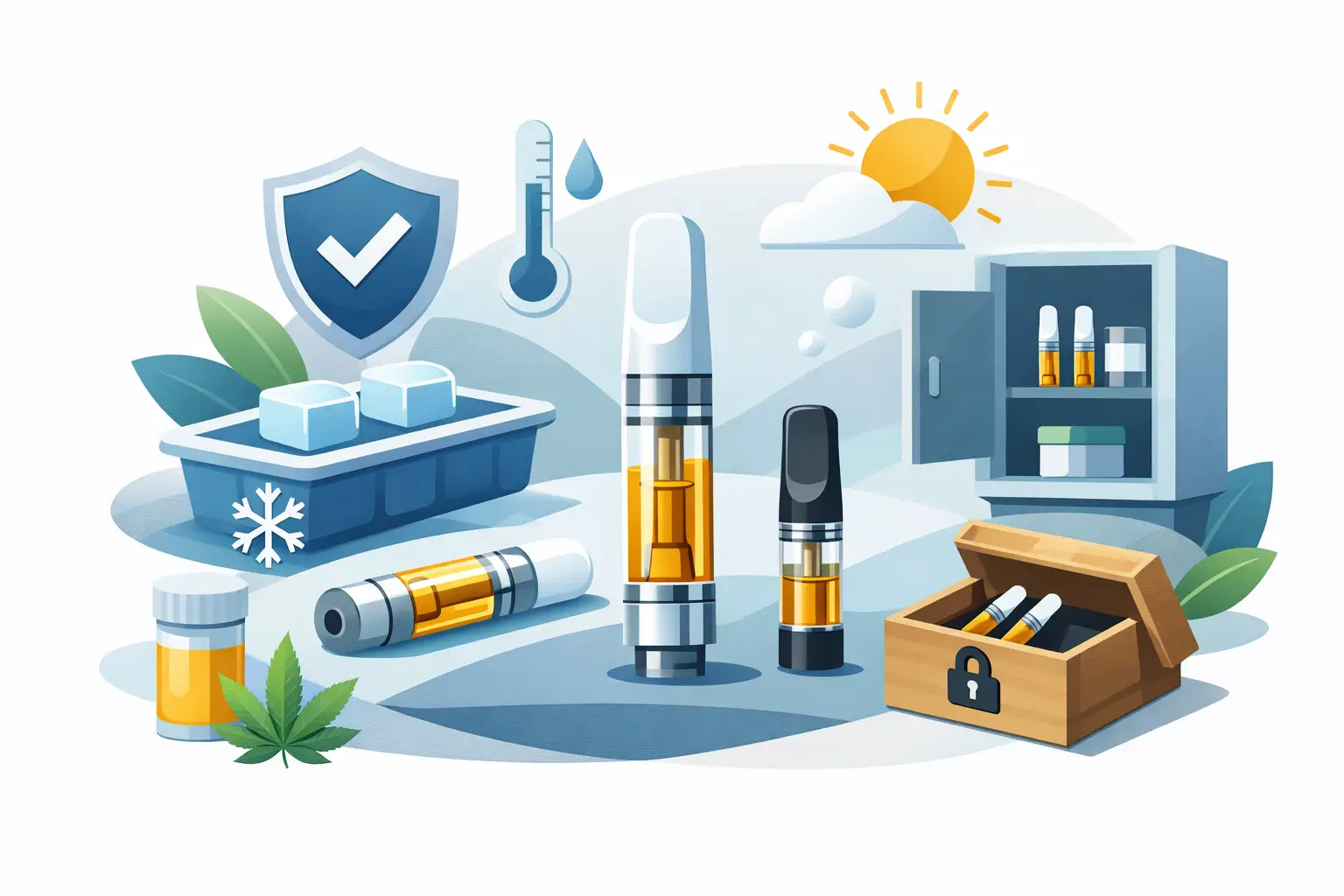
If you only follow one rule, make it this one. Store your cartridges upright. Mouthpiece up, base down.

This helps the oil stay where the hardware expects it to be. When a cart stays on its side for too long, the oil can shift unevenly and create clogging around the airway. In warmer conditions, sideways storage also raises the chance of leaks. That sticky ring near the mouthpiece or base usually did not happen by accident.

If you are storing multiple carts, a simple stand, cup, drawer organizer, or small case with vertical slots works better than tossing them into a bag. It is not about looking organized. It is about keeping the oil stable and the hardware cleaner.

Heat is the fastest way to ruin a good cart

Among all vape cartridge storage tips, avoiding heat is the big one. Excess heat thins the oil, pushes it into parts of the cartridge where it should not be, and speeds up flavor loss. Leave a cart on a windowsill, in a glove box, near a game console, or in a pocket during summer, and you are asking for weak taste and possible leaks.

Room temperature is usually the safe zone. A cool, shaded indoor spot is better than any place that gets direct sun or trapped heat. Think drawer, cabinet, or storage box in a climate-controlled room.

People sometimes assume warm oil is better because it pulls easier. For a hit, maybe. For storage, no. Warmth helps movement, and too much movement inside a cartridge is usually bad news.

Light exposure slowly chips away at flavor

Direct sunlight is a double problem because it brings heat and light at the same time. Even if the cart does not get hot enough to visibly leak, constant light exposure can still degrade the oil over time.

That matters most if you care about taste, aroma, and the full character of the oil. A cart left out on a desk by a bright window may still work, but it often will not hit the same after a while. Darker storage is smarter. Opaque cases, closed drawers, and shaded cabinets beat open counters every time.

If you rotate through carts slowly, this matters even more. A few days of bad storage might not kill a cart. A few weeks can absolutely wear it down.

Cold storage can help, but it depends

People get this wrong in both directions. Some treat the fridge like the answer to everything. Others think any cold environment ruins carts. Reality is more specific.

For short-term storage, a cool room is usually enough. For longer-term storage, lower temperatures can help preserve the oil, but extreme cold can make it too thick and slow to wick properly when you use it again. If you do store a cart in a cooler environment, let it return to room temperature before hitting it. Trying to force thick oil through the hardware is a great way to clog it.

Freezing is generally a bad move. It can stress the cartridge materials and create condensation problems when the cart warms back up. Refrigeration is also not ideal for most everyday users because fridges add moisture risk and constant in-and-out temperature changes.

So the real answer is simple. Cool and stable beats cold and dramatic.

The best vape cartridge storage tips for travel

Travel is where carts get abused. They get tossed in backpacks, left in cars, jammed into pockets, and knocked around with keys, chargers, and loose change. Then people wonder why the cart leaks or stops hitting right.

A small hard case is worth it. It protects the cartridge from impact, keeps dust off the mouthpiece, and makes upright storage easier. If you are carrying a battery and cart together, turn the battery off when possible. Some devices can auto-fire or preheat accidentally under pressure in a bag, which cooks the oil and drains the battery.

Try not to leave cartridges in your car, even for a short run inside. Cars heat up fast, and that trapped heat does more damage than most people realize. If you are on the move all day, keeping the cart on your person is often better than leaving it in a vehicle, but avoid tight pockets that stay hot for hours.

Clean hardware stores better and hits better

Storage and maintenance overlap more than most people think. A dirty mouthpiece or sticky connection point makes every storage mistake worse.

If residue builds up around the mouthpiece, airflow gets tighter and clogs become more likely. If oil collects near the base, the battery connection can get messy and performance drops off. Wiping the outside of the cartridge with a soft dry cloth once in a while helps more than people expect. If there is stubborn residue on the contact area, a light clean with a cotton swab can help, as long as you are careful and let everything dry fully before use.

This is especially useful if you are storing partially used carts. Fresh carts are one thing. Half-used carts already have some heat cycles behind them, and they need a little more respect if you want them to stay smooth.

Don’t overbuy if you can’t store properly

A big stash sounds good until half of it sits around too long in bad conditions. One of the most overlooked vape cartridge storage tips is buying according to how fast you actually use them.

If you run through carts quickly and keep them in a cool dark spot, stocking up can make sense. If you open one, ignore it for weeks, and carry three more around loose in a backpack, bulk buying can backfire. Oil is not immortal, and hardware does not improve with age.

This is where being honest with your habits matters. If your place runs warm, your routine is chaotic, or you are always traveling, a smaller rotation may keep your carts fresher than a huge stash. Better to keep a few in solid condition than a pile of carts that all hit mediocre.

Signs your storage setup is failing

You usually see the damage before the cart fully gives out. Watch for oil getting darker faster than expected, leaking around the mouthpiece or base, weak flavor, repeated clogs, bubbling in odd places, or a noticeably burnt edge on otherwise decent oil.

Not every problem comes from storage. Sometimes the cart itself is low quality. Sometimes the battery voltage is too high. But if the same issues keep happening across multiple carts, your storage habits are probably part of the problem.

A better setup does not need to be fancy. A cool drawer, upright storage, less light, and fewer heat spikes will solve most of what goes wrong.

If you want your carts to stay premium, treat them like premium products, not something to bounce around the bottom of a bag. Good oil costs money. A little discipline keeps it tasting right longer, hitting cleaner, and wasting less. That is the whole play.

Edibles Onset Time Explained Clearly

You took the gummy an hour ago, felt nothing, and now you’re staring at the bag wondering if you got a weak batch or made a rookie move. That exact gap between taking an edible and actually feeling it is where most people get into trouble. This guide on edibles onset time explained cuts through the guessing so you know what’s normal, what changes the wait, and why patience matters more with edibles than almost any other THC format.

Edibles onset time explained in plain English

Edibles do not hit like a vape or a joint. When you inhale THC, it moves through the lungs and into the bloodstream fast, so effects can show up in minutes. With edibles, the THC has to move through your digestive system, then get processed by the liver before the full experience starts building.

That extra step is the whole reason onset feels slow, uneven, and sometimes deceptive. A lot of people expect a clean, obvious switch from sober to high. Edibles usually don’t work like that. They often creep in. You may first notice a mood shift, heavier eyes, a warmer body feel, or a change in time perception before the stronger effects arrive.

For most people, onset starts somewhere around 30 to 90 minutes. In some cases it can show up sooner, and in others it can take closer to 2 hours. The full peak often lands later than people expect, usually around 2 to 4 hours after dosing. That means the mistake is not just redosing too early. It’s redosing right before the first dose is about to fully kick.

Why edibles take longer than smoking

The short version is digestion. The longer version is that edible THC follows a different route through the body, and that route changes both timing and feel.

When THC is eaten, it passes through the stomach and small intestine, then through the liver. In the liver, delta-9 THC gets converted into 11-hydroxy-THC, a metabolite many users describe as feeling heavier, more immersive, and longer-lasting than inhaled THC. That’s one reason a modest edible can feel stronger than expected, even if the milligram number did not look intimidating at first.

This is also why edible timing is messy. Food in the stomach, metabolism, body size, tolerance, and even the product formula can all shift the clock. Two people can take the same gummy from the same pack and have noticeably different onset times.

What actually affects onset time

A lot of buyers want one fixed answer, but edible timing is always a range. The biggest variable is whether you took it on an empty stomach or after eating. On an empty stomach, some people feel onset faster. But faster is not always smoother. It can also feel sharper or more intense. After a meal, onset may take longer, but the experience can build more gradually.

Product type matters too. Gummies, chocolates, baked goods, beverages, and tincture-like edible products can all move differently. A drink may come on quicker than a dense brownie. A gummy with added fats or certain emulsification methods may behave differently from a basic candy. The label tells you dosage, but it does not always tell you how the ride will unfold.

Tolerance is another big one. Frequent THC users may need higher doses for the same effects, but that does not always mean a faster onset. Sometimes experienced users confuse tolerance with timing and redose too soon because they expect an immediate signal. That’s how a chill night turns into six hours of being way more faded than planned.

Your own metabolism plays a role as well. Some people process edibles faster, some slower. Sleep, stress, hydration, and what else you consumed that day can all nudge the experience in one direction or another.

Edibles onset time explained by dose expectations

Low-dose edibles often feel sneaky at first. If you take 2.5 to 5 mg of THC, the onset may be subtle enough that you question whether it’s working. That is normal. The first signs can be light body relaxation, easier laughter, or a shift in focus rather than a dramatic head change.

At 10 mg and up, especially for low-tolerance users, onset may still take time, but the eventual build can be much more obvious. Stronger doses do not always mean faster onset. They usually mean more noticeable effects once the process is underway.

This is where people get trapped by bad logic. They think, I don’t feel it yet, so I must not have taken enough. Then the second dose stacks on top of the first. With edibles, stacking is where things go sideways fast.

A smarter rule is simple: if you are not highly experienced with that exact product, wait a full 2 hours before even considering more. If you already know your body runs slow with edibles, 3 hours is safer. It may feel cautious, but cautious beats overshot.

The biggest mistakes people make

The first mistake is chasing the feeling too early. This happens most with new users and with buyers switching from smoking to edibles. Smoking teaches you immediate feedback. Edibles punish that expectation.

The second mistake is ignoring the setting. If you took an edible in a loud environment, while moving around, distracted, or already anxious, you may miss the early signs and assume nothing is happening. Then it catches up all at once.

The third mistake is mixing without thinking. Alcohol and edibles can amplify each other in unpredictable ways. That combo can make onset feel weirder, stronger, or harder to gauge. It can also make a moderate dose feel far less manageable.

Another common issue is trusting packaging language more than actual response. “Premium,” “extra strength,” and flavor names do not tell you how your body will react. What matters is the THC content, the source, and whether the dosing is consistent from piece to piece.

How to time an edible the smart way

If your goal is a controlled experience, timing matters almost as much as dose. Take the edible when you know you have enough runway. That means no driving, no obligations, and no plan that depends on you being clearheaded in the next few hours.

If you want a more predictable first try, take a low dose after a light meal and settle in. Give it time without chasing the result. Check in with yourself at the 60-minute mark, then again at 90 and 120 minutes. Those checkpoints are useful because onset can be gradual. You’re looking for change, not impact.

If you are buying for consistency, that matters too. Products with clear dosing and reliable batch quality usually lead to fewer bad surprises than random homemade edibles or mystery packs. That’s one reason buyers who care about control pay attention to sourcing instead of just grabbing the cheapest option. If you’re browsing a larger catalog like Zazaland.shop, the real value is knowing the strength per piece and shopping formats that fit how patient or precise you want to be.

What onset feels like when it starts

For some people, it begins in the body. Shoulders drop. Limbs feel heavier. Music sounds more detailed. For others, it starts mentally with a soft shift in mood, a little extra quiet in the head, or that familiar moment where time starts stretching.

The key is that onset is not always dramatic. It can feel like nothing is happening right up until it’s clearly happening. That’s why experienced buyers learn not to measure edibles minute by minute. They measure by arc. Early rise, fuller build, peak, then the long taper.

And yes, sometimes the onset is delayed enough to make you doubt the product. That does not automatically mean bad quality. Slow onset can still lead to strong effects. Timing and strength are related, but they are not the same thing.

If it’s taking too long, what should you do?

Usually, nothing. Wait. Change the environment before you change the dose. Sit down, hydrate, eat something light if needed, and give it another 30 to 60 minutes. If you already took a moderate or high dose, adding more just because the first wave is late is how people overshoot.

If you’re the type who consistently gets very delayed onset, treat that as your baseline next time. Start earlier in the evening, use a dose you already know, and do not compare your timing to someone else’s. Edibles are personal, not standardized by vibes.

There’s also a bigger point here. Fast does not always mean better. A slower build can be smoother, longer-lasting, and easier to work with if you respect the timeline.

Edibles reward patience and punish ego. If you remember that, the wait stops feeling like a problem and starts feeling like part of the plan.

What Are Cannabis Concentrates? A Straight Answer

If you’ve ever looked at a menu and seen wax, shatter, live resin, rosin, sauce, or diamonds and thought, what are cannabis concentrates, you’re not the only one. The short answer is simple: concentrates are cannabis products made by pulling the most active compounds out of the plant – mainly cannabinoids like THC and CBD, plus terpenes that shape flavor and aroma – and leaving behind most of the excess plant material.

That sounds technical, but the real-world difference is easy to understand. Flower is the full plant bud. Concentrates are the dense, high-potency version. Less bulk, more punch. For buyers who want stronger effects, cleaner flavor, or a faster route to the result they’re after, concentrates sit in a different lane than standard bud.

What are cannabis concentrates, really?

Think of the cannabis plant as a raw source material. The compounds most people care about are packed into tiny resin glands called trichomes. Concentrates are made by collecting and refining that resin. Depending on the method, the final product can come out sticky, glassy, buttery, saucy, crumbly, or almost crystal-like.

The reason concentrates matter is potency. Regular flower often lands somewhere around the low-to-mid double digits in THC percentage, depending on quality and strain. Concentrates can go much higher. That means a smaller amount can deliver a much stronger experience. For some people, that’s the whole point. For others, it’s exactly why they need to approach concentrates with more respect.

Concentrates also change the flavor game. When extraction preserves more terpenes, the product can taste brighter, louder, and closer to the plant’s original profile. That’s why experienced buyers often care just as much about resin quality and terpene content as they do about raw THC numbers.

How cannabis concentrates are made

There are two broad lanes: solvent-based and solventless.

Solvent-based concentrates use substances like butane, propane, or CO2 to strip cannabinoids and terpenes from the plant material. Done right, this can produce very pure, potent extracts with strong flavor and a polished texture. Products like shatter, wax, badder, sauce, and many live resin extracts usually fall into this category. The upside is efficiency and high potency. The trade-off is that quality depends heavily on proper extraction and purging.

Solventless concentrates skip chemical solvents and rely on heat, pressure, water, ice, or mechanical separation. Hash, bubble hash, and rosin are the main examples. Rosin, for instance, is made by pressing cannabis flower, hash, or kief under heat and pressure until the resin squeezes out. A lot of buyers like solventless options because the process feels cleaner and more straightforward. The trade-off is that yields can be lower, and premium solventless products often cost more.

This is where quality starts separating itself fast. Two products can both be labeled concentrate and still be miles apart in taste, smoothness, and overall effect. Starting material matters. Extraction method matters. Post-processing matters. Storage matters. Cheap input usually shows up in the final product.

The main types of cannabis concentrates

The category is crowded, but most products fit into a few familiar groups.

Wax, badder, and budder

These are soft, workable concentrates with a whipped or creamy texture. They’re popular because they’re easy to handle compared with brittle forms like shatter. Depending on the terpene content and processing, they can range from dry and crumbly to wet and rich. Buyers who want a strong concentrate without dealing with glass-like snap often gravitate here.

Shatter

Shatter is known for its hard, translucent, sheet-like texture. It breaks apart rather than scoops. When it’s well made, it looks clean and stable. It can be potent and effective, but texture alone doesn’t guarantee quality. Good shatter should still have a solid cannabinoid and terpene profile, not just look flashy.

Live resin

Live resin is made from fresh-frozen cannabis rather than dried and cured flower. That usually helps preserve more of the plant’s original terpene profile, which is why live resin tends to get attention from people chasing flavor and strain character. It often comes with a saucy, glossy texture and a louder aroma than more stripped-down extracts.

Rosin

Rosin is the solventless favorite for a lot of buyers. No chemical solvent extraction, just pressure and heat. Flower rosin exists, but hash rosin is usually the premium tier. People choose rosin for flavor, purity perception, and a more craft-style appeal. It’s not always the cheapest option, and not every batch is elite, but top-tier rosin has a loyal following for a reason.

Hash and bubble hash

Hash is one of the oldest concentrate styles. Traditional hash compresses separated resin glands into a dense form. Bubble hash uses ice water and filtration to isolate trichomes, often resulting in a cleaner and more refined product. Some bubble hash is smoked on its own, while higher-end grades may be used to make rosin.

Distillate

Distillate is highly refined and usually heavy on a single cannabinoid, often THC. It’s common in vape carts, edibles, and infused products. The main draw is potency and versatility. The downside is that distillate can feel one-dimensional if terpenes are stripped out and not reintroduced. If someone wants pure strength, distillate gets the job done. If they want a fuller plant profile, they may prefer resin or rosin.

Why concentrates hit harder than flower

The answer is concentration. Instead of smoking plant material that contains cannabinoids among everything else in the bud, you’re using a product where those compounds have been condensed. That means stronger effects in smaller amounts.

But strength isn’t the whole story. The onset can feel faster, especially with dabbing or vaping. The flavor can be more pronounced. The experience can also be less forgiving if you overdo it. Someone comfortable with flower can still get blindsided by a concentrate if they treat it the same way. A little can go a long way.

This is why format matters. A low-temp dab of terpene-rich live resin may feel very different from a hard pull off a distillate cart, even if both are technically concentrates. Potency, terpene profile, and delivery method all shape the effect.

What to look for before you buy

Not all concentrates are worth your money. Texture and branding catch attention, but they shouldn’t be the whole decision.

Start with the type of experience you want. If flavor matters most, live resin and rosin are usually where the conversation starts. If you want raw THC efficiency for carts or infused products, distillate may make more sense. If you want an old-school resin-heavy feel, hash still has a place.

Then look at consistency and freshness. A concentrate shouldn’t seem dried out, contaminated, or strangely unstable for its category. Aroma matters too. Terpenes should smell clear and intentional, not flat, burnt, or chemical-heavy.

It also pays to understand that expensive doesn’t always mean better. Some buyers overpay for hype names and flashy labels. Others buy the cheapest gram they can find and wonder why the taste is rough and the effect feels dirty. The smart move is knowing the product style, the extraction lane, and the quality of the source material.

For buyers shopping online, trust and discretion matter just as much as product type. If you’re sourcing from a marketplace like Zazaland.shop, the appeal is simple: broad selection, fast browsing, private checkout, and a cleaner route to finding the exact format you want without bouncing between sellers.

Are cannabis concentrates right for everyone?

Not really. That’s the honest answer.

For experienced users with higher tolerance, concentrates can be efficient, flavorful, and cost-effective in a different way than flower. You use less product to get where you want to go. For casual users or people with low tolerance, concentrates can feel like too much, too fast. The upside becomes the downside if the dose gets away from you.

Your setup matters too. Some concentrates are easiest with a dab rig or e-rig. Others fit neatly into vape formats. Some are messy if you don’t know what you’re handling. If convenience is the main goal, carts and easy-load extracts may make more sense than sticky jars of sauce.

There’s also the question of preference. Some people love the ritual and flavor of flower and don’t care about max potency. Others want concentrated effects, less smoke, and a more refined terpene profile. Neither side is wrong. It depends on what kind of session you’re after.

What are cannabis concentrates worth knowing for first-time buyers?

If you’re new, the biggest thing to understand is that concentrates are not just stronger weed. They’re a separate category with different textures, extraction methods, flavor profiles, and intensity levels. Treating them like flower is where a lot of people misjudge the experience.

If you want a balanced entry point, terpene-rich options with clear labeling tend to make more sense than chasing the highest THC number on the page. Potency sells, but quality shows up in flavor, smoothness, and consistency. A concentrate that hits clean and tastes right usually tells you more than a giant percentage ever will.

The best way to think about concentrates is simple: they’re the cannabis plant with the volume turned up. That can be a win if you know what you’re buying and why you want it. If you slow down long enough to match the product to the experience you actually want, you’ll make better picks and waste a lot less money.

Crypto Payments for Online Stores That Sell

Card processors freeze funds. Banks flag orders. Chargebacks eat margin. If you run ecommerce in a space that gets extra scrutiny, crypto payments for online stores stop being a trendy add-on and start looking like basic infrastructure. The real question is not whether customers know what crypto is. It is whether your checkout makes paying simple enough that they actually finish the order.

For a lot of stores, the old payment stack creates more friction than trust. A customer gets to checkout, sees limited options, worries about declines, and bounces. With crypto, that pressure changes. You give buyers a direct payment route, cut out some of the usual middlemen, and create a checkout flow that fits privacy-first customers better. That does not mean crypto fixes every problem. It does mean stores that understand how to use it well can convert buyers who would never complete a card-first purchase.

Why crypto payments for online stores keep gaining ground

The biggest reason is simple – certain customers prefer paying in crypto because it feels more private, more direct, and less exposed than putting card details into yet another store. That preference is not limited to one niche. It shows up anywhere buyers care about discretion, international access, or avoiding card declines.

From the merchant side, the appeal is just as practical. Traditional processors can hold reserves, reverse payments, or close accounts with little warning if they do not like your category, fulfillment pattern, or risk profile. Crypto changes that model. Once payment is confirmed on-chain, the transaction is generally final. That can reduce chargeback exposure and make revenue more predictable.

Still, there is a trade-off. Finality protects the seller, but it also means customer service has to be tighter. If a buyer sends the wrong amount or uses the wrong network, you need a clear process for handling it. Stores that win with crypto do not treat it like magic. They treat it like an operational system.

What customers actually want at crypto checkout

Most shoppers do not care about blockchain theory. They care about whether payment takes two minutes or ten. They care about whether the wallet address is correct, whether the instructions are clear, and whether the order updates fast enough that they know their money did not disappear into a void.

That is why the best crypto payments for online stores feel familiar. The customer picks a coin, sees the exact amount due, gets a countdown if pricing is time-sensitive, and receives confirmation once payment lands. Simple beats clever every time.

Choice matters too, but only to a point. Offering one or two widely used coins is often better than flooding checkout with every token on the market. Too many options can look messy and create support issues. If your audience strongly prefers certain assets, meet them there first. Build around buyer behavior, not around what sounds impressive.

The business case is bigger than payment privacy

Privacy gets the attention, but it is not the whole story. Crypto can also improve cash flow and lower payment friction in categories where card acceptance is inconsistent. If your business deals with frequent payment failures, crypto may recover revenue that would otherwise be lost before the order is even placed.

There is also a branding angle. Accepting crypto can signal that your store understands how your buyers already move online. That matters when your audience values speed, discretion, and direct transactions. A checkout that matches those expectations feels more credible than one that forces customers through clunky workarounds.

That said, crypto alone does not build trust. Bad product pages, vague shipping policies, and slow support will still kill conversion. Payment is one part of the buying experience. It works best when the rest of the store looks organized, confident, and clear about what happens after the order is placed.

How to set up crypto payments for online stores without killing conversion

Start with the checkout flow, not the technology stack. A lot of merchants obsess over wallet integrations and forget that confusion is what loses the sale. Before you choose a processor or payment method, decide what the customer sees from cart to confirmation.

The cleanest approach is to keep the steps short. Show the accepted coin, the exact payment amount, the network, and the wallet address in one place. Add a QR code for mobile users. Make the post-payment status obvious. If confirmation takes time, say that upfront instead of leaving the customer guessing.

Pricing also needs attention. If you quote in dollars and accept crypto, exchange rate movement has to be managed somehow. Many stores use a short payment window so the amount stays fixed for a limited time. That protects both sides from volatility during checkout. If you leave rates open-ended, disputes become more likely.

You should also think hard about operations after payment. Order matching, payment verification, and refund handling need rules. If a customer underpays by a few dollars because price moved, will you contact them, credit partial value, or cancel the order? If they send funds on the wrong chain, what happens next? The stores that look trustworthy answer these questions before they need to.

Where stores get it wrong

One common mistake is making crypto sound easier than it is. Buyers appreciate directness. They do not appreciate vague promises. If confirmation can take several minutes, say so. If only certain coins are accepted, say so. If refunds are store credit only, say so before payment.

Another mistake is treating crypto buyers like they are all experts. Plenty of them are comfortable enough to pay, but not technical enough to troubleshoot network mismatches or fee issues on their own. Your instructions should be written for a customer who wants the order done fast, not for someone who spends all day in wallet apps.

There is also a temptation to overcomplicate privacy messaging. Customers who prefer crypto usually already understand the basic appeal. You do not need to turn checkout into a manifesto. Focus on practical trust signals instead – fast confirmation, accurate totals, clear support, and order updates that arrive when promised.

Choosing between self-managed and processor-based crypto payments

Some stores want full control and prefer a self-managed wallet setup. Others want automation, easier reconciliation, and less manual work, so they use a payment processor. Neither option is automatically better. It depends on your risk tolerance, technical comfort, and order volume.

A self-managed setup offers more control, but it puts more responsibility on your team. You handle payment monitoring, accounting, and customer exceptions directly. That can work for smaller operations or stores with a very specific workflow.

A processor-based setup can simplify checkout and back-office tasks. It may help with invoice creation, payment tracking, and conversion into fiat if needed. The trade-off is less direct control and possible dependency on a service provider. For many merchants, the right answer is the one that keeps checkout smooth while reducing manual errors.

How crypto fits stores built around discretion and repeat buyers

For privacy-focused ecommerce, crypto often does more than process payments. It shapes the whole buying experience. A buyer who wants discretion is usually looking for less friction, less exposure, and fewer awkward steps. Crypto supports that when the store uses it well.

Repeat customers especially tend to value consistency. If they know the checkout process is fast, the payment instructions are accurate, and orders move quickly after confirmation, crypto becomes part of why they come back. The payment method stops feeling experimental and starts feeling standard.

That is where stores like Zazaland.shop can gain an edge. When the catalog is broad and the audience is already crypto-comfortable, a clean private checkout is not just a feature. It is part of the sales engine. But that only works if the rest of the experience backs it up with speed, clarity, and follow-through.

The real standard is not adoption – it is execution

Plenty of merchants now accept crypto. Fewer make it easy. That gap matters more than raw adoption numbers. Customers will use crypto payments for online stores when the process feels fast, clear, and dependable. They will abandon it when checkout feels risky, confusing, or slow.

If you are thinking about adding crypto, think less about hype and more about buyer behavior. What makes your customers hesitate? Where do payments fail now? What information do they need to finish the order without opening a support ticket? Those answers shape a better checkout than any buzzword ever will.

The stores that keep sales moving are the ones that remove doubt at the exact moment a buyer is ready to pay. If crypto helps you do that, it is worth treating as a serious part of your storefront, not a side option buried at the bottom of the page.

How Discreet Shipping Works for Online Orders

Privacy usually matters most right before you hit checkout. That is the moment people start asking how discreet shipping works, what actually shows up on the box, and whether a delivery is going to attract attention from roommates, neighbors, or anyone handling the package along the way. The short answer is simple: discreet shipping is built to keep the contents from being obvious, while making the order look like any other standard ecommerce delivery.

That sounds straightforward, but the details matter. Packaging, labels, sender names, payment records, and delivery steps all play a part. If you are ordering something sensitive, the difference between “plain box” marketing talk and actual privacy practices is worth understanding before you buy.

How discreet shipping works in real terms

At its core, discreet shipping means the outside of the package is intentionally plain. There is usually no product branding splashed across the mailer, no item name printed on the box, and no obvious wording that tells a third party what is inside. A properly discreet shipment is designed to blend in with the flood of normal packages moving through the system every day.

That usually starts with packaging materials. Sellers often use plain cardboard boxes, standard padded mailers, or generic shipping envelopes. The goal is not to make the package look suspiciously overengineered. It is to make it look boring. A package that looks ordinary is less likely to draw curiosity than one covered in logos, stickers, or specialty product labels.

The shipping label matters just as much. In most cases, the label will show the recipient address, tracking information, and a return address or sender name that does not describe the product category. That does not mean there is no sender listed at all. It usually means the sender information is neutral, abbreviated, or tied to a generic business identity rather than the exact store name or product line.

What discreet shipping does and does not protect

This is where people get tripped up. Discreet shipping is about reducing visibility, not creating invisibility. It helps keep the contents from being obvious to casual observers, but it does not turn a shipped order into something untraceable or immune from shipping carrier processes.

For example, a plain mailer can prevent a neighbor from guessing what you bought off the porch. It can also reduce awkwardness if someone in your household sees the package before you do. What it does not do is erase the fact that a package was sent to your address, or guarantee that no shipping information exists in carrier systems, merchant order records, or payment records.

That distinction matters because privacy has layers. Packaging privacy is one layer. Billing privacy is another. Account security, order notifications, and where you receive the package are separate pieces of the same puzzle.

The parts of discreet shipping that matter most

If you are comparing online stores, look past the headline claim and pay attention to how the process is described. A seller that takes privacy seriously will usually be clear about a few basics.

First, there is outer packaging. Plain, unbranded materials are the baseline. Second, there is label discretion. The sender name should not reveal the product type. Third, there is order handling. Sensitive orders should be packed in a way that keeps items secure and prevents obvious shifting, leaking, or damage in transit. Fourth, there is communication. Emails, order confirmations, and tracking messages should be neutral enough that they do not expose more than necessary if someone else sees your screen.

In other words, discreet shipping is not just about the box. It is about every point where information could become more visible than the buyer wants.

How discreet shipping works from checkout to doorstep

The process usually begins when the order is placed. Once payment clears, the order is picked, packed, and assigned a shipping label. At that stage, the seller decides how much product information stays internal and how much appears in customer-facing messages. Better privacy practices keep product names out of obvious subject lines and public-facing label details.

After packing, the package enters the regular carrier stream. That means it is sorted, scanned, transported, and delivered like any other parcel. The benefit of discreet shipping is that, during this process, the package does not announce what it contains. To a warehouse worker, courier, front desk employee, or neighbor, it should look like another routine delivery.

At delivery, the last privacy factor is location. If packages are left in a shared mailroom, apartment lobby, or front porch, discretion still helps, but your environment matters. A plain package protects you more effectively than a branded one, but it cannot control who has access to the drop-off point.

Why people choose discreet shipping

The reasons are usually practical, not dramatic. Some buyers live with family or roommates and do not want every package turning into a conversation. Others work in offices or buildings where deliveries pass through reception. Some simply do not like broadcasting their purchases, whether the item is personal care, supplements, adult products, or anything else they would rather keep private.

That is why discreet shipping has become a standard expectation in many sensitive product categories. Privacy is part of the service. People want the convenience of online ordering without turning the package itself into an announcement.

There is also a trust angle. When a store explains its packaging and labeling practices clearly, it signals that the company understands buyer concerns. That does not automatically make the seller better in every way, but it does show attention to a pain point that matters to a lot of customers.

Common misconceptions about discreet shipping

One common mistake is assuming discreet shipping means no return address at all. In reality, most shipments still need sender information for carrier and delivery reasons. The privacy piece is that the sender is typically presented in a neutral way.

Another misconception is that discreet shipping means vacuum sealing, scent proofing, or special handling in every case. Sometimes sellers add extra protective layers depending on the product type, but discreet shipping as a general term usually refers first to plain external presentation. Additional packaging methods depend on the item, the shipping route, and the merchant’s standards.

People also assume every store defines the term the same way. They do not. One seller may mean plain brown boxes. Another may mean generic labels and neutral email notifications. Another may bundle in signature options or extra internal wrapping. If privacy matters to you, vague promises are not enough. Look for specifics.

What to check before placing an order

The smartest move is to read the store’s shipping and privacy information closely. Look for direct language about unbranded packaging, neutral sender names, and how tracking communications are handled. If the wording is all hype and no detail, that is a sign to slow down.

You should also think about your own setup. If your building has package theft issues, a plain box helps with discretion but not with security. If you share access to your email, neutral shipping notices matter. If you are concerned about who sees the package first, delivery timing and location matter almost as much as the packaging itself.

This is where a store’s broader process matters too. A seller can promise discreet shipping, but if checkout confirmations are overly descriptive or customer service messages include sensitive product names in plain text, the privacy picture gets weaker fast.

Discreet shipping and customer trust

Good discreet shipping feels uneventful. That is the point. No loud branding, no obvious product identifiers, no unnecessary exposure. When done right, the package arrives looking like standard ecommerce mail, and the transaction stays as low profile as possible.

For buyers, that kind of normalcy is valuable. It removes friction from ordering and cuts down on the small but real stress that can come with receiving sensitive items by mail. For sellers, it is part of earning repeat business. Privacy is not just a shipping feature. It is part of the customer experience.

If you are evaluating a store, treat discreet shipping the same way you would treat any service claim. Look for clear explanations, not just big promises. A serious operation knows that privacy starts before the package ships and continues until it lands at your door. That is the standard worth expecting, whether you are making a one-time purchase or ordering from a trusted source like Zazaland.shop.

The best discreet shipping does not try to look clever – it tries to look ordinary, because ordinary is exactly what keeps a private order private.

Difference Between CBD and THC Explained

If you have ever looked at a cart menu, edible label, or tincture description and thought these two compounds sound similar but hit completely different, you are asking the right question. The difference between CBD and THC matters because one is mostly chosen for a non-intoxicating effect, while the other is the cannabinoid people usually associate with getting high.

A lot of product confusion starts with the plant itself. CBD and THC both come from cannabis. They also interact with the body in related ways. But the experience, intensity, side effects, legal status, and reasons people buy them can be very different. If you are trying to figure out what fits your goals, the details matter more than the hype.

What is the difference between CBD and THC?

At the simplest level, THC is the main psychoactive compound in cannabis, and CBD is not considered intoxicating in the same way. THC changes perception, mood, and coordination more noticeably. CBD is usually sought out by people who want a calmer, more clear-headed experience without the classic cannabis high.

That sounds clean on paper, but real-world use is more nuanced. Dose changes everything. Product format matters. Your tolerance matters. Even the same cannabinoid can feel different depending on whether it is in a gummy, vape, flower, capsule, or tincture.

THC, or tetrahydrocannabinol, binds more strongly to the receptors in the body that influence mood, appetite, memory, and perception. That is why it is usually linked to euphoria, altered senses, stronger body effects, and impairment. CBD, or cannabidiol, interacts more indirectly. It does not typically produce the same mental shift, and many people describe it as subtle unless the dose is dialed in correctly.

How CBD and THC feel in real use

The easiest way to understand the difference is to focus on effects instead of chemistry terms.

THC is usually chosen for a noticeable experience. Depending on the dose and strain profile, it may feel euphoric, heavy, giggly, spacey, sleepy, hungry, creative, or overstimulating. Some people want exactly that. Others take a little too much and end up anxious, foggy, or glued to the couch.

CBD is usually chosen for balance. People often use it when they want to take the edge off, settle down, or support relaxation while staying functional. That does not mean CBD always feels dramatic. In many cases, it is more of a background effect than a front-and-center one.

There is also a common middle ground. Some people prefer products that combine both cannabinoids because CBD may soften some of THC’s sharper edges. A balanced ratio can feel smoother than high-THC products alone. But ratios are not magic. A product with a lot of THC can still feel very strong, even if it includes CBD.

Why people choose one over the other

A lot of buyers are not looking for a science lecture. They want to know what to buy for the result they want.

People usually pick THC when they want a stronger mood shift, a recreational high, a heavier body effect, or a more obvious edible or vape experience. It is often the choice for nighttime use, social use, or situations where the psychoactive effect is the point.

People usually pick CBD when they want to stay more clear-headed, avoid feeling too high, or try a cannabis-derived product without major intoxication. It is often the choice for daytime use, first-time users, or people who are sensitive to THC.

The overlap is where things get interesting. Some people find pure CBD underwhelming and prefer at least a little THC. Others find even small amounts of THC too intense and stick with broad-spectrum or isolate CBD products. There is no single best option. It depends on your tolerance, your body, and whether you want to feel altered or stay steady.

The legal difference between CBD and THC

This is one area where people make expensive mistakes.

In the US, hemp-derived CBD is more widely available if it contains no more than 0.3% delta-9 THC by dry weight under federal rules. But state laws still vary, and product categories get messy fast. Some CBD products contain trace THC. Some are broad-spectrum and claim no THC. Some are isolate-based and aim for pure CBD only.

THC is regulated much more tightly. Marijuana-derived THC remains federally illegal, even though many states allow medical or adult-use sales. That means legality depends heavily on your location and the exact form of THC involved.

There is also confusion around hemp-derived intoxicating cannabinoids such as delta-8 or certain converted compounds. People often treat them as a legal shortcut, but the rules shift constantly and enforcement is not always predictable. If legality matters to you for work, travel, or testing, do not assume the label tells the whole story.

Drug testing changes the decision

For some buyers, this is the only section that matters.

THC is the main cannabinoid associated with failing a drug test. If you are using THC products, there is a real risk of testing positive. That risk goes up with regular use, higher doses, and edibles.

CBD is not usually the target of standard drug screens, but that does not make every CBD product risk-free. Full-spectrum CBD may contain enough THC to create problems over time, especially with repeated use. Mislabeling also happens. If avoiding THC is critical, broad-spectrum or isolate products are usually the safer lane, but even then, zero-risk claims should be treated carefully.

Side effects and trade-offs

Neither cannabinoid is perfect, and both can disappoint you if the product or dose is wrong.

THC side effects can include anxiety, dry mouth, red eyes, faster heart rate, short-term memory issues, dizziness, and impaired coordination. For some users, especially beginners, too much THC turns a good night into a long, uncomfortable one.

CBD side effects are usually milder, but they can still happen. Some people report drowsiness, stomach upset, appetite changes, or a flat feeling if the dose is too high. It can also interact with certain medications, which is one reason blanket wellness claims around CBD should always be viewed with some caution.

The trade-off is simple. THC is usually stronger and more noticeable, but also more likely to cause impairment and paranoia. CBD is usually gentler and easier to fit into daily life, but some users expect more than it actually delivers.

Product types make a big difference

The cannabinoid is only part of the story. Delivery method changes the whole experience.

Vapes and flower hit faster, so both THC and CBD effects show up quickly and are easier to adjust in the moment. Edibles take longer, last longer, and are where many people overdo THC because they think nothing is happening and take more. Tinctures sit somewhere in the middle, while capsules feel more controlled but less immediate.

A 10 mg THC gummy and a CBD vape are not comparable products, even if both come from cannabis. That is why reading only the front label is not enough. You need to know the dose per serving, total cannabinoid content, and whether the product is full-spectrum, broad-spectrum, or isolate.

How to choose without wasting money

If you are deciding between CBD and THC, start with your goal, not the trend.

If you want a psychoactive effect, THC is the obvious lane. If you want little to no intoxication, start with CBD. If you want something in between, a balanced product may make more sense than going all in on one side.

Start low, especially with THC. That advice gets repeated for a reason. A low dose can be adjusted. A high edible dose cannot be untaken. With CBD, expectations should be realistic. Some people feel a clear benefit. Others need time, consistency, or a different format before they notice much.

Quality matters too. Clean labeling, actual cannabinoid amounts, and product consistency are what separate a decent experience from guesswork. If you are shopping options at Zazaland.shop, the smartest move is still to read the specs, compare strengths, and choose based on the effect you actually want instead of chasing the loudest product title.

Difference between CBD and THC for beginners

For beginners, the best rule is not to confuse stronger with better.

THC is not automatically the right choice just because it is more famous. CBD is not automatically the better choice just because it sounds safer. The right pick depends on whether you want a buzz, whether you need to stay functional, how sensitive you are, and how much uncertainty you are willing to tolerate.

A lot of experienced users end up appreciating both for different reasons. CBD can make sense for lighter, more controlled use. THC can make sense when you want a clear, unmistakable effect. The smart move is knowing which lane you are stepping into before you take the first hit or eat the first gummy.

If you remember one thing, make it this: CBD and THC may come from the same plant, but they are not interchangeable, and choosing well starts with being honest about the experience you actually want.

Cannabis Product Dosage Guide That Makes Sense

You do not really care what a label says if the high hits twice as hard as expected. That is where a real cannabis product dosage guide matters. Not the vague stuff, not the guesswork, and definitely not the buddy advice that starts with trust me. If you are using flower, vapes, edibles, tinctures, or concentrates, dosage changes everything – how fast it hits, how long it lasts, and whether the session stays smooth or turns into an all-night mistake.

Why a cannabis product dosage guide matters

The biggest mistake people make is treating all cannabis products like they work the same way. They do not. Ten milligrams in an edible is not the same as a few pulls from a vape, and neither of those feels like a couple hits off flower. The route changes the onset, intensity, and duration.

Your own tolerance matters too. If you use every day, your baseline is different from someone taking their first gummy on a Friday night. Body size can play a role, but tolerance, product type, and how recently you ate usually matter more. That is why good dosing is less about chasing a magic number and more about reading the format in front of you.

Start low still wins

This sounds basic because it works. If you are new, returning after a break, or trying a stronger product than usual, start lower than you think you need. You can always take more. You cannot untake a dose that comes on late.

That matters most with edibles and concentrates. People get impatient, stack another dose too soon, and then spend the next few hours wishing they had not. A smart session is paced, not rushed.

Flower dosage guide

Flower is usually the easiest format to control because the effects show up fast. You take one inhale, wait a few minutes, and decide whether you want more. That quick feedback makes it more forgiving than edibles.

For low tolerance users, one to two small puffs can be enough. Moderate tolerance users may land closer to three to five pulls over a short session. Heavy users may need more, but stronger flower can still catch up fast, especially if the THC percentage is high.

The trade-off with flower is consistency. Two strains with the same THC number can feel different. Terpenes, freshness, and how deep you inhale all change the experience. If you want more control, keep the first round light and give it 10 to 15 minutes before adding more.

Vape dosage guide

Vapes hit quickly like flower, but they are often easier to overdo because they feel smooth. A cartridge with high THC can stack fast, and the lack of harsh smoke can trick people into taking repeated pulls without realizing how much they are consuming.

If you are new to vaping, start with one short pull and wait 10 minutes. If you have some tolerance, two to three pulls may be a normal starting point. The mistake is chain-hitting a cart because the effects can keep building after the first few minutes.

This is also where potency matters more than people admit. A high-THC distillate cart is not a casual flower session in a pen. Treat it with more respect than the hardware suggests.

Edibles dosage guide

If people search for a cannabis product dosage guide, edibles are usually the reason. They are simple to use and easy to mess up. The onset is slow, usually 30 minutes to 2 hours, and the high lasts much longer than inhaled cannabis.

For beginners, 2.5 mg to 5 mg THC is a cautious starting range. For many casual users, 5 mg to 10 mg is enough. More experienced users may choose 10 mg to 20 mg or higher, but once you move up, mistakes get harder to manage because the ride is longer.

Eating before dosing can change how fast it hits. So can the type of edible. Gummies, chocolates, and baked products may feel slightly different in onset, but the bigger issue is patience. If you take 5 mg and feel nothing after 40 minutes, that does not mean it failed. Waiting the full 2 hours before redosing is the safer move.

Tincture dosage guide

Tinctures sit in the middle. They can be measured more precisely than flower and may kick in faster than edibles, especially if held under the tongue for 30 to 60 seconds before swallowing. That makes them a decent choice for people who want more control without smoking.

Most tinctures list milligrams per bottle and often per dropper. That label matters. A full dropper is not automatically one dose. Some bottles are lightly dosed, while others pack a lot of THC into a small amount of liquid.

For newer users, 2.5 mg to 5 mg THC is still a smart starting range. Moderate users may prefer 5 mg to 10 mg. The upside of tinctures is cleaner measurement. The downside is that people sometimes eyeball the dropper and end up taking double what they intended.

Dabs and concentrates

Concentrates are where small amounts can hit very hard. Wax, shatter, live resin, rosin, and similar products carry much higher THC levels than flower, so dosage has to be tighter. This is not the format to treat casually if your tolerance is low.

A beginner-sized dab should be tiny – really tiny. Think a small speck, not a fat scoop. Even regular cannabis users can get blindsided by concentrates if they are used to flower only. The effects come on quickly and can feel much more intense.

If you are stepping into dabs, the best move is one very small amount, then wait 10 to 15 minutes. There is no prize for taking a giant first hit.

What changes your dose

A cannabis product dosage guide works better when you know what shifts the experience. Tolerance is the obvious one, but not the only one. If you have not used in weeks, your normal dose may no longer be normal. If you mix cannabis with alcohol, the effects can get stronger and less predictable.

Your setting matters too. A familiar place with food, water, and nowhere to be feels very different from taking a strong edible before going out. Time of day, stress level, and whether you are trying to relax or stay functional all shape what the right dose looks like.

Then there is product quality. Reliable potency matters. A clean, clearly labeled product gives you a better shot at repeatable dosing than something inconsistent. That is why people who care about control usually stick with sources they trust, not random pickups with no usable info.

If you take too much

It happens. Usually the move is not to panic and definitely not to keep stacking other substances trying to fix it. If you overdo it, slow everything down. Sit somewhere calm, drink water, and remind yourself the effects will pass.

With inhaled cannabis, the peak usually fades faster. With edibles, it can take longer, which is why they cause so many bad nights. If possible, avoid driving, avoid making decisions, and avoid taking more. Rest, light snacks, and a quiet space help more than people think.

How to build your own baseline

The best dosing is personal, and it gets easier when you stop guessing. Use the same product more than once before deciding how strong it is. Keep track of how much you took, how long it took to hit, and whether it was too light, just right, or too much.

That kind of pattern matters more than internet bravado. One person says 50 mg is nothing. Another gets flattened by 10 mg. Both can be telling the truth. Your baseline is what counts.

If you are buying across formats, stay aware that switching products changes the rules. A comfortable vape dose does not translate neatly to an edible, and a good flower session does not prepare you for a heavy concentrate hit. If you want more consistency, buy with dosage in mind, not just THC hype. On stores with broad selections, including places like Zazaland.shop, that means reading the format and potency before you click, not after the package lands.

A good session usually starts the same way – less than enough, then a little more only if you actually need it.

Benefits of Buying Medications Online from Zazaland.shop

Shopping for medications online offers numerous benefits, especially when choosing a reliable pharmacy like zazaland.shop. Whether you’re seeking convenience, affordability, or discreet service, online pharmacies can meet your needs effectively. In this article, we’ll explore the top benefits of buying medications online from zazaland.shop.

Benefit 1: Convenience and Accessibility
Order medications from the comfort of your home without visiting a pharmacy. Zazaland.shop is available 24/7, making it easy to refill prescriptions anytime.

Benefit 2: Competitive Prices
Online pharmacies often offer better prices than brick-and-mortar stores. We provide affordable medications without compromising quality.

Benefit 3: Wide Selection of Products
Access a broad range of medications, including hard-to-find prescriptions, all in one place. Zazaland.shop stocks a comprehensive inventory to meet your health needs.

Benefit 4: Discreet and Confidential Service
Maintain your privacy with discreet packaging and confidential shopping experience. We respect your privacy at every step.

Benefit 5: Easy Reordering and Prescription Management
Save time with streamlined reordering and prescription management tools. Our user-friendly platform makes medication management simple.

Benefit 6: Fast and Reliable Shipping
Receive your medications quickly and securely at your preferred address. We prioritize timely delivery and discreet packaging.

Why Zazaland.shop Stands Out:

  • Fully licensed and VIPPS certified
  • Prescription verification required
  • Secure payment options
  • Excellent customer support
  • Discreet shipping and packaging

Buying medications online from Zazaland.shop offers unparalleled convenience, affordability, and privacy. Trust our licensed pharmacy for all your medication needs and experience a safer, easier way to manage your health.

How to Identify a Legitimate Online Pharmacy

With countless online pharmacies available, distinguishing between legitimate and illegitimate sites can be challenging. Buying from a fake or unlicensed pharmacy can jeopardize your health. In this guide, we’ll provide seven key tips to help you identify a trustworthy online pharmacy and why zazaland.shop meets all these criteria.

Tip 1: Check for Licensing and Certification
A legitimate pharmacy will display licenses and certifications from health authorities like NABP or VIPPS. Zazaland.shop proudly displays our licensing information, confirming our credibility.

Tip 2: Require a Prescription
Reputable pharmacies always ask for a valid prescription from a licensed healthcare provider. We enforce this policy strictly to ensure compliance and safety.

Tip 3: Look for Clear Contact Information
Authentic pharmacies provide detailed contact info, including physical address, phone number, and email. Zazaland.shop offers transparent contact details for your peace of mind.

Tip 4: Use Secure Website Features
Verify the site uses HTTPS with secure encryption. Our website guarantees your personal and financial data are protected.

Tip 5: Read Customer Reviews
Check independent review sites for feedback about the pharmacy’s reputation. Zazaland.shop has numerous positive reviews from satisfied customers.

Tip 6: Beware of Unrealistic Prices
Prices significantly lower than average may indicate illegitimacy. We offer fair, competitive prices on all our medications.

Tip 7: Ensure Discreet and Fast Shipping
A trustworthy pharmacy ships discreetly and delivers promptly. We prioritize fast, discreet shipping to ensure your privacy and satisfaction.

Why Choose Zazaland.shop?

  • Licensed and VIPPS certified
  • Prescription verification enforced
  • Secure, encrypted transactions
  • Transparent contact info
  • Excellent customer support

Spotting a legitimate online pharmacy is crucial for your health and safety. By following these tips, you can confidently choose a trusted provider like zazaland.shop for your medication needs.

Add to cart